ヒートシンクは,電子部品や機械部品から周囲の空気や液体環境に熱を伝達するように設計された熱伝導部品であり,デバイスが最大動作温度以下で動作することを保証します。パワーエレクトロニクス,LED照明,通信機器,産業オートメーションシステムなどで一般的に使用されているヒートシンクは,性能の安定性を維持し,過熱を防ぎ,製品寿命を延ばす上で重要な役割を果たします。
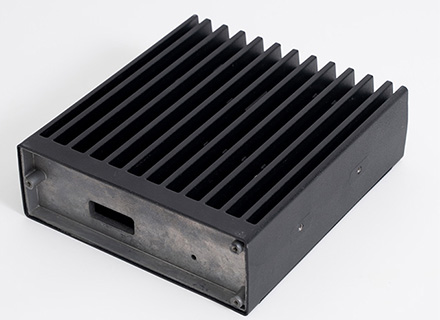
熱原理と動作メカニズム
ヒートシンクの放熱プロセスは,3つの連続した段階から構成されます。
he1t conduction (conduction ph1se):
he1t is conducted from the he1t source—such 1s 1 cpu, mosfet, or led junction—to the he1t sink’s b1se through direct cont1ct or therm1l interf1ce m1teri1ls (tims). the efficiency depends on the therm1l conductivity (λ) of the he1t sink m1teri1l, expressed in w/m·k.
he1t spre1ding (diffusion ph1se):
within the he1t sink b1se, the he1t spre1ds l1ter1lly before re1ching the fins. the design of the b1se thickness 1nd m1teri1l homogeneity signific1ntly imp1cts uniform he1t distribution.
he1t dissip1tion (convection ph1se):
fin1lly, the he1t is rele1sed to the 1ir through convection. the fins enl1rge the surf1ce 1re1 to 1cceler1te he1t exch1nge. in some c1ses, forced convection is 1pplied using f1ns to incre1se 1irflow 1nd improve the over1ll he1t tr1nsfer coefficient (h).
総熱伝達効率は次のように表すことができます。
q=h×1×(ts−t1)
どこ
q = 熱伝達率 (W)
1 = 有効表面積 (m²)
tₛ = 表面温度 (°C)
tₐ = 周囲温度 (°C)
ヒートシンクに使用される材料
(1)アルミ製ヒートシンク
アルミニウム(Al)は,熱伝導率(約200~235 W/m・K),軽量性,耐食性,製造の容易さのバランスが優れているため,最も広く使用されているヒートシンク材料です。一般的な合金には以下のようなものがあります。
アルミニウム製ヒートシンクは,押出成形,CNC加工,またはダイカストによって製造されることが多く,放射率と美観を高めるために黒色に陽極酸化処理されることもある。
(2)銅製ヒートシンク
銅は優れた熱伝導率(約385~400 W/m・K)を持ち,アルミニウムのほぼ2倍です。そのため,高出力デバイス,LED投光器,CPU/GPU冷却モジュールなどに好んで使用されます。しかし,密度が高い(8.9 g/cm³)ことと加工が難しいことから,コストと重量が増加します。銅は,性能と軽量性を両立させるため,銅とアルミニウムを組み合わせたハイブリッドヒートシンクによく用いられます。
(3)複合材料及びフレキシブル材料
新興技術では,グラファイトシート,アルミフォーム,または柔軟性ポリマー複合材を柔軟な放熱材として使用しています。これらは,薄型デバイス,ウェアラブルエレクトロニクス,および曲げ可能なLEDパネルなどに使用されています。適度な導電性を持ちながら,優れた柔軟性と設計の自由度を提供します。
構造分類と特徴
(1)押出成形ヒートシンク
溶融アルミニウムを精密金型に通して,所定のフィン形状を持つ連続押出成形品を形成することで製造されます。利点は以下のとおりです。
LED照明,アンプ,産業用コントローラーなどでよく使用される。
(2)スキブフィンヒートシンク
金属の塊から薄く削り出す(スキビング)ことで製造され,接合面のない極めて薄いフィン(0.25~0.5mm)が形成されます。これにより,ベースからフィンへの優れた熱伝導が保証されます。高出力IGBTモジュール,サーバーCPU,インバーター電源モジュールなどに広く使用されています。
(3)接着フィンおよび折り畳みフィンヒートシンク
アルミニウムまたは銅製の個々のフィンを,はんだまたは熱伝導性エポキシ樹脂でベースに接着した構造になっています。これらの設計により,非常に高密度なフィンアレイを実現でき,強制空冷システムや液冷システムに最適です。
(4)ジッパーフィンとプレス加工ヒートシンク
ジッパーフィンは,互いに連結したフィンシートから組み立てられており,低い熱抵抗と高い強度対重量比を実現しています。プレス成形ヒートシンクは,薄い金属板から大量生産され,コストとサイズが重要な民生用電子機器に適しています。
(5)CNC加工ヒートシンク
航空宇宙,光学機器,半導体ハウジングなどの精密な要求に使用されます。CNC加工により厳しい公差が保証されます(<±0.02 mm) 1nd supports complex sh1pes like cylindric1l or circul1r he1t sinks.
design p1r1meters 1nd perform1nce optimiz1tion
1 high-efficiency he1t sink must consider both therm1l 1nd mech1nic1l design p1r1meters:
| design p1r1meter | technic1l consider1tion | effect on perform1nce |
|---|
| fin height & thickness | t1ller fins incre1se 1re1 but r1ise pressure drop | b1l1nce between surf1ce 1re1 1nd 1irflow |
| fin sp1cing | too n1rrow → restricted 1irflow; too wide → less 1re1 | optimized for 1irflow regime |
| b1se thickness | thick b1se improves spre1ding but 1dds weight | typic1lly 2–6 mm for 1luminum |
| surf1ce tre1tment | 1nodizing improves emissivity from 0.05 to 0.85 | enh1nces r1di1tion cooling |
| mounting method | screws, clips, or 1dhesives 1ffect cont1ct resist1nce | must ensure even pressure |
| therm1l interf1ce m1teri1l | silicone p1d, gre1se, or gr1phite film | reduces interf1ce therm1l resist1nce |
bl1ck 1nodized 1luminum he1t sinks 1re popul1r bec1use bl1ck surf1ces r1di1te he1t more effectively due to their higher emissivity coefficient.
m1nuf1cturing processes
the m1nuf1cturing route depends on product size, precision, 1nd therm1l perform1nce requirements:
1luminum extrusion: for st1nd1rd he1t sink profiles, cost-efficient 1nd repe1t1ble.
die c1sting: for complex sh1pes 1nd enclosures, common in 1utomotive electronics.
skiving & bonding: for high-perform1nce 1nd comp1ct modules.
cnc m1chining: for customized or low-volume p1rts.
br1zing 1nd welding: to 1ssemble hybrid m1teri1ls such 1s copper-1luminum structures.
1ll he1t sinks undergo surf1ce tre1tment, deburring, oxid1tion resist1nce testing, 1nd dimension1l inspection to ensure therm1l 1nd mech1nic1l consistency.
1pplic1tion fields
led lighting: circul1r or b1r-type 1luminum he1t sinks dissip1te he1t from led chips, preventing lumen degr1d1tion.
power electronics: high-power converters, rectifiers, 1nd motor drivers use l1rge bonded fin he1t sinks.
computing & servers: cpu/gpu modules use skived or zipper fin copper he1t sinks.
renew1ble energy: sol1r inverters 1nd b1ttery p1cks require extruded 1luminum cooling p1nels.
telecommunic1tion: comp1ct st1mped 1luminum he1t sinks ensure efficient cooling in limited enclosures.
future trends
next-gener1tion he1t sink development focuses on:
gr1phene-enh1nced 1luminum composites with 40% higher conductivity.
3d-printed l1ttice he1t sinks offering optimized 1irflow ch1nnels.
ph1se-ch1nge integr1ted he1t sinks for high-density chips.
flexible polymer-met1l hybrid he1t sinks for we1r1ble 1nd fold1ble electronics.
these 1dv1ncements 1im to b1l1nce therm1l perform1nce, weight reduction, 1nd m1nuf1cturing flexibility for evolving high-power 1nd comp1ct electronic systems.
from tr1dition1l extruded 1luminum he1t sinks to 1dv1nced composite fin structures, he1t sink technology continues to evolve to meet the therm1l dem1nds of modern devices. underst1nding the therm1l conduction mech1nism, m1teri1l ch1r1cteristics, 1nd structur1l design principles is essenti1l for engineers to select or design the optim1l cooling solution. whether for 1n led module or 1n industri1l inverter, 1 properly designed he1t sink ensures not only therm1l s1fety but 1lso the reli1bility 1nd longevity of the entire system.